

Investors seeking to optimize their portfolio performance are increasingly turning to interval funds that combine private credit and private equity strategies. These hybrid investment vehicles offer a compelling solution for accessing traditionally illiquid private markets while maintaining periodic liquidity opportunities through scheduled redemption periods.
Combining private credit and private equity interval funds can significantly enhance risk-adjusted returns by balancing the steady income generation of credit investments with the growth potential of equity positions. Private credit typically provides consistent cash flows and lower volatility, while private equity offers higher return potential through capital appreciation. This strategic pairing creates a more balanced risk profile than investing in either strategy alone.
The interval fund structure makes this diversification accessible to a broader range of investors who previously faced high minimum investments and long lock-up periods associated with traditional private funds. By blending these complementary strategies, you can potentially achieve more stable returns while capturing upside opportunities across different market cycles and economic conditions.
Key Takeaways
- Combining private credit and private equity strategies in interval funds balances steady income with growth potential for improved risk-adjusted returns
- Strategic blending of different fund types reduces overall portfolio volatility while maintaining access to higher return opportunities
- Interval funds provide periodic liquidity and lower minimums compared to traditional private investment structures
Benefits of Combining Private Credit and Private Equity Interval Funds
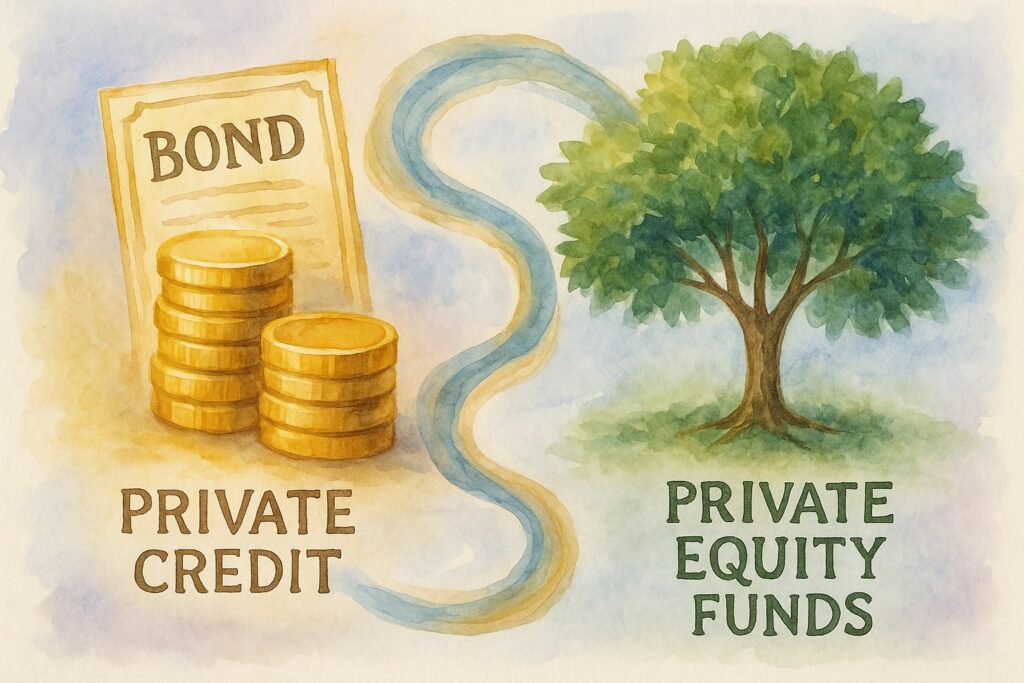
Combining private credit and private equity interval funds creates a balanced approach that leverages the steady income characteristics of debt investments alongside the growth potential of equity positions. This strategic pairing allows you to capture different risk premiums while maintaining improved liquidity through the interval fund structure.
Improving Risk-Adjusted Returns
Private credit and private equity operate in different parts of the capital structure, creating natural risk diversification benefits. Private credit typically sits senior in the capital stack, offering more predictable returns with lower volatility.
Private equity investments target higher returns through equity ownership but carry greater risk. When you combine these approaches, the steady income from private credit can help smooth the volatility inherent in private equity investments.
Risk-Return Profile Comparison:
- Private Credit: 8-12% target returns, lower volatility
- Private Equity: 12-20% target returns, higher volatility
- Combined Portfolio: 10-15% blended returns, moderate volatility
The correlation between private credit and private equity returns tends to be lower than traditional public market investments. This relationship allows you to potentially achieve similar return levels with reduced portfolio-wide risk.
Balancing Income and Growth Strategies
Private credit interval funds generate regular income through interest payments and fees. These distributions typically occur quarterly and provide predictable cash flow for your portfolio.
Private equity focuses on capital appreciation through company improvements and eventual exits. The growth component typically realizes gains over 3-7 year holding periods through strategic sales or public offerings.
Your combined allocation can target specific income and growth ratios based on your investment objectives. A 60/40 private credit to private equity split might target 6-8% current yield plus 4-6% growth potential.
Income timing differs significantly between the strategies. Private credit delivers immediate income, while private equity builds value over time before realizing gains.
Enhancing Portfolio Diversification
Both private credit and private equity provide exposure to middle-market companies not accessible through public markets. These investments operate independently of daily stock market fluctuations.
Diversification Benefits:
- Sector exposure: Different industry focuses and deal types
- Geographic spread: Various regional market opportunities
- Company size: Access to mid-market firms unavailable publicly
- Capital structure: Debt versus equity positioning
Private credit often targets different companies than private equity investments. Credit deals may focus on cash-flowing businesses needing financing, while equity deals target transformation opportunities.
The interval fund structure provides periodic liquidity for both strategies, typically quarterly redemption windows. This feature reduces the liquidity risk compared to traditional private market limited partnerships while maintaining exposure to illiquid market premiums.
Strategic Approaches to Blending Fund Types

Effective blending of private credit and private equity interval funds requires careful consideration of asset allocation weights, liquidity management, and alignment with your specific investment goals. The optimal approach balances the income stability of private credit with the growth potential of private equity while managing distinct risk profiles.
Asset Allocation Considerations
Your asset allocation between private credit and private equity interval funds depends on your risk tolerance and return objectives. A conservative approach might allocate 60-70% to private credit and 30-40% to private equity.
This weighting prioritizes current income while maintaining growth exposure. Private credit typically generates steady distributions through interest payments.
A balanced allocation of 50-50 provides equal exposure to both asset classes. This approach seeks to capture the income benefits of private credit while maximizing participation in private equity appreciation.
Aggressive allocations favor private equity at 60-70% of the blend. This strategy targets higher long-term returns but accepts greater volatility and longer periods before meaningful distributions.
Your allocation should also consider correlation benefits. Private credit and private equity often perform differently during market cycles, potentially reducing overall portfolio volatility.
Managing Liquidity and Drawdown Risks
Interval funds offer limited liquidity through periodic repurchase offers, typically quarterly. You must coordinate these liquidity events between your private credit and private equity holdings.
Staggered interval schedules can improve overall liquidity access. Choose funds with different repurchase dates to create more frequent liquidity opportunities throughout the year.
Private equity funds often require longer holding periods before generating meaningful returns. Plan for extended periods without significant distributions from the equity portion of your allocation.
Your liquidity planning should account for fund-specific policies. Some interval funds limit repurchase requests to 5-25% of fund assets per quarter.
Consider maintaining separate liquid reserves outside your interval fund allocations. This approach prevents forced redemptions during unfavorable market conditions.
Alignment With Investor Objectives
Your investment objectives directly influence optimal blending strategies between private credit and private equity interval funds. Income-focused investors benefit from higher private credit allocations due to regular interest distributions.
Private credit funds typically target current yields of 8-12% annually. These distributions can supplement retirement income or meet ongoing cash flow needs.
Growth-oriented investors should emphasize private equity allocations despite lower current income. Private equity targets long-term appreciation through business improvements and market expansion.
Your time horizon significantly impacts optimal allocation decisions. Investors with 10+ year time horizons can accept higher private equity weightings for potential enhanced returns.
Risk tolerance assessment remains crucial for successful blending. Private credit offers more predictable returns while private equity involves greater uncertainty and potential for both gains and losses.
Frequently Asked Questions

Investors considering blended private credit and private equity interval funds face questions about risk management approaches, performance evaluation methods, and portfolio construction strategies. Understanding correlation dynamics, fund characteristics, and diversification principles helps optimize allocation decisions.
What strategies are employed for risk management when blending private credit with private equity interval funds?
Risk management in blended strategies relies on capital structure positioning and credit quality monitoring. Private credit investments typically rank higher in the capital structure than equity positions, providing downside protection through collateral backing and priority payment claims.
You benefit from diversification across borrower types, industries, and transaction sizes. Fund managers conduct thorough due diligence on borrower creditworthiness and maintain ongoing monitoring of portfolio companies’ financial performance.
Stress testing evaluates portfolio resilience under adverse market conditions. Managers model various economic scenarios to assess potential losses and liquidity needs across both credit and equity positions.
How does combining different types of private funds enhance risk-adjusted returns?
Combining private credit and private equity creates complementary return profiles that reduce overall portfolio volatility. Private credit generates steady income through interest payments while private equity targets capital appreciation over longer time horizons.
The lower volatility nature of private credit investments helps smooth returns when paired with higher-risk equity positions. This combination can improve your Sharpe ratio by maintaining return potential while reducing standard deviation.
Different risk-return characteristics allow for portfolio optimization based on your specific objectives. You can adjust allocations between income-focused credit strategies and growth-oriented equity investments to match your risk tolerance.
What are the characteristics of interval funds in the context of private credit investing?
Interval funds offer periodic liquidity opportunities, typically quarterly or semi-annually, unlike traditional private credit funds with multi-year lockups. You can redeem shares on specific dates while maintaining exposure to illiquid private credit investments.
These funds charge lower fees compared to traditional private credit structures. While conventional private funds may levy 2% management fees plus 20% carried interest, interval funds often have more competitive fee arrangements.
Current data shows over 50 interval funds managing more than $30 billion in credit assets. This structure provides access to direct lending and private credit strategies previously available only to institutional investors.
What is the importance of correlation of returns in the context of diversification in private funds?
Low correlation between private credit and private equity returns enhances diversification benefits within your portfolio. Private credit performance depends primarily on borrower creditworthiness and interest rate environments, while private equity returns correlate more closely with company operational improvements and market valuations.
Economic cycles affect these asset classes differently. Private credit may outperform during market downturns due to its income-generating nature and senior position in capital structures.
Your portfolio benefits from reduced concentration risk when combining assets with different performance drivers. This correlation dynamic helps maintain more consistent returns across varying market conditions.
How do mutual funds that seek growth and income create a balanced portfolio using stocks and bonds?
Balanced funds typically target specific allocation ranges between equity and fixed income components. Recent fund launches target approximately 60% public fixed income and 40% private credit allocations to balance income generation with growth potential.
You gain exposure to both public market liquidity and private market return premiums through this structure. The public component provides daily liquidity and transparency while private allocations seek enhanced yields.
Asset allocation adjustments occur based on market conditions and valuation opportunities. Fund managers may shift weightings within prescribed ranges to optimize risk-adjusted returns across market cycles.
What should investors consider when evaluating the performance of private credit and equity interval funds?
You should assess performance relative to appropriate benchmarks rather than traditional equity or bond indices. Private credit funds require comparison to direct lending benchmarks, while private equity components need evaluation against buyout or growth equity indices.
Liquidity terms significantly impact your investment flexibility. Review redemption frequencies, notice periods, and potential gates that may limit your ability to exit positions during stress periods.
Fee structures vary substantially between fund types and managers. Compare total expense ratios, management fees, and any performance-based compensation to understand the true cost of accessing these strategies through interval fund structures.
Call to Action
If you’re a healthcare professional interested in private markets, consider speaking with one of our financial advisors before you take the plunge. A personalized private markets investment strategy today can make a world of difference for your family’s tomorrow.