

Locum tenens physicians face unique financial challenges that traditional investment strategies often fail to address. Your unpredictable income streams, frequent relocations, and irregular work schedules create a complex financial landscape that requires specialized solutions.
Direct indexing offers locum tenens physicians the tax efficiency and customization needed to optimize investments around their variable income and lifestyle demands. Unlike traditional mutual funds or ETFs, direct indexing allows you to own individual stocks that mirror an index while maintaining control over tax-loss harvesting and individual holdings.
This investment approach aligns perfectly with the flexibility that draws physicians to locum tenens work in the first place. You can adjust your investment strategy as your assignments change, harvest losses during high-income periods, and customize your portfolio to match your values and financial goals without being locked into rigid fund structures.
Key Takeaways
- Direct indexing provides tax optimization opportunities that align with the irregular income patterns of locum tenens physicians
- The investment strategy offers customization and flexibility that matches the adaptable lifestyle locum physicians prefer
- Individual stock ownership within an index framework allows for better control over timing and tax management than traditional funds
Understanding Direct Indexing
Direct indexing allows you to own individual stocks that replicate an index rather than purchasing fund shares. This approach provides direct ownership while maintaining diversification benefits that traditional index investing offers.
How Direct Indexing Works
You purchase individual shares of each company within a specific index like the S&P 500. Instead of buying one fund that holds all these stocks, you own each stock directly in your account.
Your portfolio mirrors the index’s weightings. If Apple represents 7% of the S&P 500, it will represent approximately 7% of your direct indexing portfolio.
Key mechanics include:
- Direct stock ownership in your brokerage account
- Proportional weighting based on the target index
- Automatic rebalancing to maintain index alignment
- Individual stock transactions for each holding
Zero-commission trading platforms have made this strategy accessible to investors with smaller portfolios. Previously, transaction costs made direct indexing viable only for accounts exceeding $250,000.
Key Differences Between Direct Indexing and Traditional Index Funds
| Direct Indexing | Traditional Index Funds |
|---|---|
| Own individual stocks | Own fund shares |
| Control over individual holdings | No control over underlying stocks |
| Tax-loss harvesting opportunities | Limited tax control |
| Customization possible | No customization |
| Higher minimum investments | Lower minimum investments |
Ownership structure differs significantly between approaches. Direct indexing gives you actual stock certificates, while index funds provide shares in a pooled investment vehicle.
Tax implications vary considerably. You can harvest losses on individual stocks with direct indexing. Index funds only allow tax-loss harvesting at the fund level.
Customization options exist with direct indexing. You can exclude specific sectors or companies based on personal preferences or ethical considerations.
Benefits of Personalization in Direct Indexing
You can customize your portfolio to align with personal values and investment goals. This includes excluding tobacco companies, fossil fuel businesses, or other sectors that conflict with your beliefs.
Tax optimization becomes more sophisticated through individual stock ownership. You can harvest losses on specific holdings while maintaining your overall index exposure.
Fractional shares allow precise portfolio weighting even with smaller account balances. You can maintain exact index proportions regardless of individual stock prices.
ESG integration becomes seamless when you control individual holdings. You can apply environmental, social, and governance criteria without sacrificing diversification.
Your investment timeline flexibility increases significantly. You can hold certain positions longer for tax advantages while rebalancing others as needed.
Why Direct Indexing Appeals to Locum Tenens Physicians
Direct indexing offers locum tenens physicians unique advantages that traditional investment vehicles cannot match. The flexibility to customize holdings for irregular income patterns, enhanced tax management capabilities, and the ability to align investments with personal values make it particularly suitable for temporary medical professionals.
Customizing Investments for Irregular Income
Your income as a locum tenens physician fluctuates significantly based on assignment availability and duration. Traditional investment strategies often assume steady monthly contributions, which doesn’t match your reality.
Direct indexing allows you to adjust your investment timing around your assignment schedule. When you complete a high-paying assignment, you can increase contributions immediately rather than waiting for the next month.
You can also customize your portfolio’s risk allocation based on upcoming assignments. If you have several months of confirmed work, you might increase equity exposure. During uncertain periods between assignments, you can shift to more conservative holdings.
Tax-loss harvesting becomes more valuable with irregular income. You can strategically realize losses during high-earning periods to offset taxes, then potentially buy back similar positions during lower-income months without wash sale restrictions.
The ability to hold individual stocks rather than fund shares gives you granular control. You can sell specific tax lots to optimize your tax situation based on your current year’s earnings.
Tax Advantages for Physicians with Variable Earnings
Locum tenens work creates complex tax situations that direct indexing can help manage effectively. Your income varies dramatically year to year, making traditional tax planning challenging.
Tax-loss harvesting occurs automatically throughout the year with direct indexing. This feature becomes crucial when you have unexpectedly high earnings from multiple assignments in one tax year.
You can time capital gains realization to coincide with lower-income periods. If you have a gap between assignments, you might realize gains when you’re in a lower tax bracket.
Direct indexing platforms typically provide detailed tax reporting that integrates with tax software. This simplifies the complex record-keeping required for contractors with multiple income sources.
The strategy works particularly well if you have substantial taxable portfolios from previous high-earning years. You can optimize the tax efficiency of existing holdings while maintaining broad market exposure.
Unlike ETFs, direct indexing doesn’t force you to accept unwanted capital gains distributions at inconvenient times during your tax year.
Aligning Portfolios with Professional and Ethical Preferences
Your work in healthcare exposes you to various medical and pharmaceutical companies. Direct indexing lets you exclude specific stocks that conflict with your professional experience or ethical views.
You can exclude pharmaceutical companies involved in practices you disagree with while maintaining healthcare sector exposure through other holdings. This granular control isn’t possible with broad market ETFs.
ESG customization allows you to emphasize companies with strong healthcare access initiatives. You might overweight firms developing affordable medical technologies or those improving healthcare delivery.
Some locum tenens physicians prefer to avoid hospital chains they’ve worked with and found problematic. Direct indexing makes these exclusions simple while preserving diversification.
You can also tilt toward healthcare innovation companies developing solutions to problems you’ve witnessed firsthand. This creates alignment between your professional insights and investment strategy.
The flexibility extends to geographic preferences based on your assignment experiences. You might favor companies headquartered in regions where you’ve enjoyed working.
Implementing Direct Indexing for Flexibility
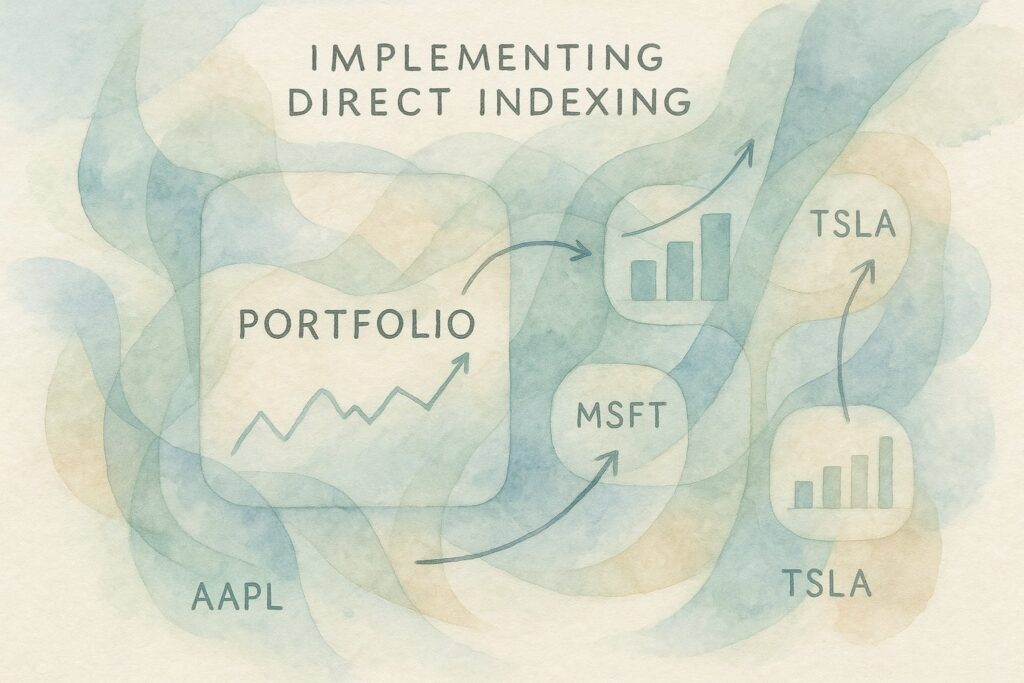
Direct indexing implementation for locum tenens physicians requires strategic adjustments to accommodate irregular income patterns and frequent location changes. The approach must balance investment customization with the practical realities of transitional work assignments.
Adapting Investments to Lifestyle Changes
Your investment strategy needs to reflect the unique aspects of locum tenens work. Income variability between assignments requires a flexible approach to portfolio contributions.
Set up automated investment thresholds based on assignment completion rather than monthly schedules. This allows you to invest larger amounts when contracts end and income arrives in lump sums.
Create separate buckets for different time horizons:
- Emergency fund: 6-12 months of expenses
- Assignment gap fund: 3-6 months for transition periods
- Long-term investments: Direct indexing portfolios
Consider tax-loss harvesting timing around your assignment schedule. Peak harvesting opportunities often occur during career transitions when you might experience lower income periods.
Geographic diversification becomes crucial when your work locations change frequently. Avoid overconcentration in regional banks or local utility companies that might not align with your mobile lifestyle.
Managing Portfolio Rebalancing During Assignment Transitions
Rebalancing presents unique challenges when your income and location change regularly. Traditional quarterly rebalancing may not align with your cash flow patterns.
Implement event-driven rebalancing instead of calendar-based approaches. Trigger rebalancing when you complete assignments and receive payment rather than on fixed dates.
Use these rebalancing triggers:
- Assignment completion (major cash inflow)
- Portfolio drift exceeding 5% from target allocation
- Significant market movements during assignment gaps
Automate rebalancing through robo-advisors or direct indexing platforms when possible. This ensures portfolio maintenance continues even when you’re focused on new assignments or relocating.
Consider tax implications of rebalancing timing. If you expect lower income during transition periods, delay selling appreciated positions until those times to minimize tax impact.
Incorporating Direct Indexing Into Comprehensive Financial Planning
Direct indexing works best when integrated with your complete financial picture as a locum tenens physician. Your planning must account for irregular income and potential gaps between assignments.
Coordinate with retirement accounts to avoid asset overlap. If your 401(k) holds S&P 500 funds, consider direct indexing in international or small-cap markets for diversification.
Plan for state tax implications when working across multiple states. Direct indexing’s tax-loss harvesting benefits become more complex with multi-state tax obligations.
Cash flow planning requires special attention. Maintain higher cash reserves than traditional employees due to assignment gaps and relocation expenses.
Create a systematic approach:
| Assignment Phase | Direct Indexing Action | Cash Management |
|---|---|---|
| Active assignment | Minimal trading | Build cash reserves |
| Assignment end | Major rebalancing | Lump sum investing |
| Gap period | Tax-loss harvesting | Draw from reserves |
| New assignment prep | Portfolio review | Relocate liquid funds |
Link your direct indexing strategy to major life decisions like permanent practice transitions or geographic preferences that may develop over time.
Frequently Asked Questions
Direct indexing presents unique opportunities and challenges for locum tenens physicians navigating irregular income patterns and flexible career paths. Tax implications, investment comparisons, and risk management become critical considerations for medical professionals in temporary assignments.
How does direct indexing benefit locum tenens physicians in managing unpredictable income?
Direct indexing allows you to customize your investment approach around irregular payment schedules. You can strategically time tax-loss harvesting to offset high-income periods when you complete lucrative assignments.
The flexibility to adjust individual stock holdings means you can respond quickly to income fluctuations. During months with multiple assignments, you can increase contributions without being locked into predetermined mutual fund schedules.
You maintain better control over when to realize gains or losses. This timing flexibility becomes valuable when your income varies significantly between assignment-heavy and lighter work periods.
Are there specific tax considerations for locum tenens physicians using direct indexing strategies?
Tax-loss harvesting through direct indexing can offset the higher tax brackets you encounter during busy assignment periods. You can harvest losses strategically to reduce taxable income when working multiple high-paying contracts.
Multi-state tax obligations require careful planning with direct indexing portfolios. You need to consider how different state tax rates affect your investment timing decisions across various assignment locations.
Business expense deductions for travel and temporary housing can be coordinated with investment tax planning. Direct indexing gives you more precise control over generating offsetting losses when needed.
What impact does lifestyle flexibility have on investment choices for locum tenens physicians?
Your unpredictable schedule requires investment strategies that don’t demand constant monitoring. Direct indexing platforms typically offer automated rebalancing that works around your varying availability.
Geographic flexibility means you can work in different markets and time zones. This lifestyle demands investment approaches that function independently of your physical location or work schedule.
Career uncertainty inherent in locum work influences your risk tolerance and liquidity needs. Direct indexing allows you to maintain more liquid positions compared to locked-up alternative investments.
Can direct indexing help locum tenens physicians in meeting their long-term financial goals?
Direct indexing provides the customization needed to align investments with irregular contribution patterns. You can build wealth systematically even when your income arrives in unpredictable chunks throughout the year.
The tax efficiency of direct indexing becomes more valuable as your income increases through high-demand specialties. You can optimize after-tax returns during peak earning periods in your locum career.
Portfolio customization allows you to exclude healthcare stocks if you prefer not to concentrate risk in your industry. This diversification becomes important when your career already depends heavily on healthcare market conditions.
How does direct indexing compare to traditional investment options for transient medical professionals?
Traditional mutual funds lack the tax flexibility you need to manage irregular income patterns effectively. Direct indexing provides superior tax-loss harvesting opportunities compared to fund-based approaches.
ETFs offer lower costs but don’t provide the customization benefits of direct indexing. You sacrifice the ability to harvest individual stock losses and customize sector exposures.
Target-date funds assume steady contribution patterns that don’t match locum income reality. Direct indexing adapts better to your variable cash flow and changing time horizons between assignments.
What are the potential risks involved with direct indexing for individuals in locum tenens roles?
Higher complexity requires more sophisticated tax and investment knowledge than traditional fund investing. You may need professional guidance to maximize benefits while avoiding costly mistakes.
Minimum investment requirements for many direct indexing platforms can be substantial. Your irregular income might make it challenging to meet these thresholds consistently.
Increased administrative burden includes tracking individual stock positions for tax purposes. This complexity adds to the already demanding requirements of managing multi-state tax obligations and business expenses.
Next Steps? SUBMIT INQUIRY